When you hand a project to an outsourced team, what really decides whether it goes smoothly is not talent on its own. It is whether there is a defined process behind the work. Talented people with no shared system still trip over handoffs, unclear ownership, and the small things nobody wrote down.
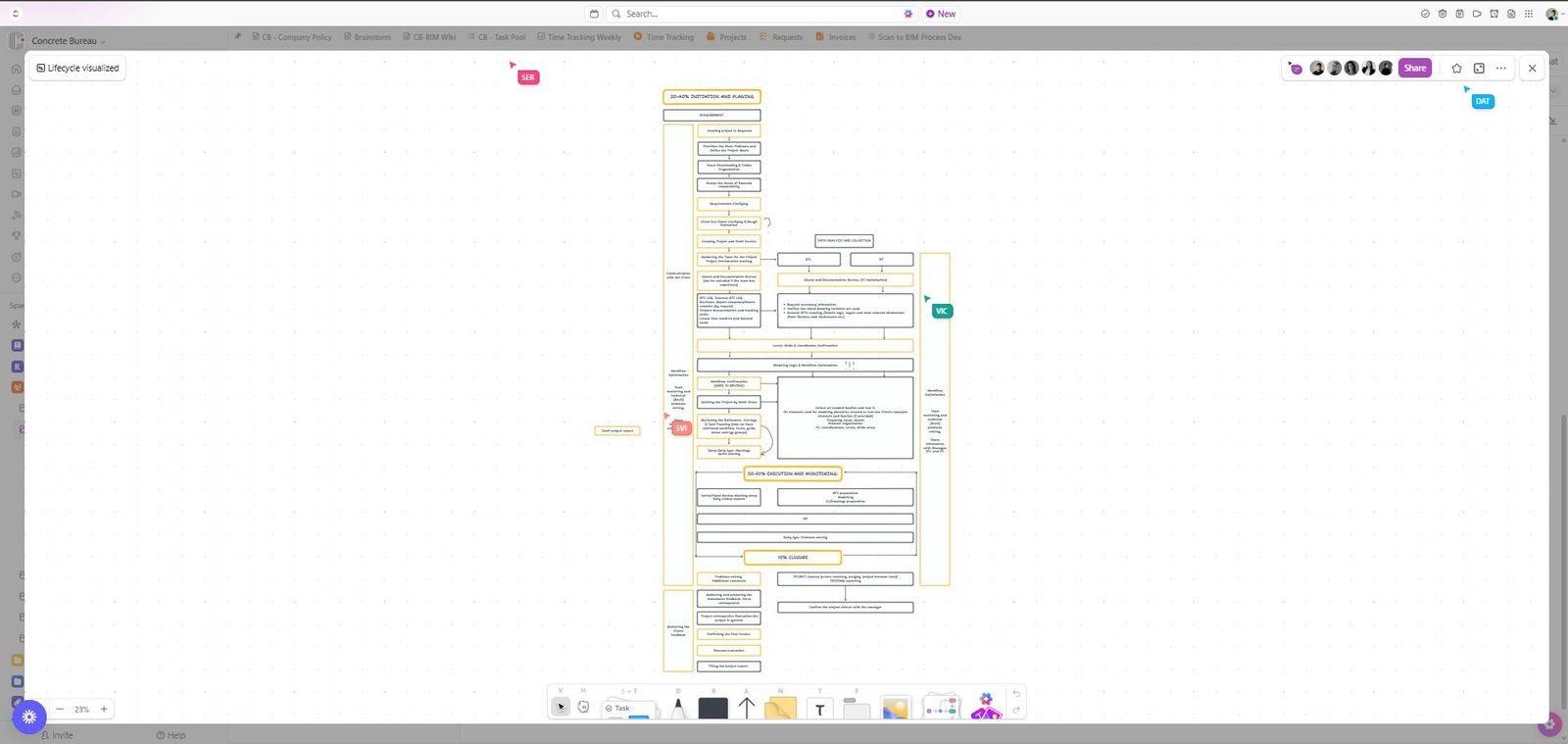
So we mapped our full project lifecycle and turned it into a structured process, with clear ownership at every stage and the management, technical, and client-communication threads connected rather than running in separate lanes. This is how a project actually runs when you work with us.
A defined lifecycle, not improvisation
The point of the framework is to make the whole path from kickoff to handover repeatable, including the parts that usually stay invisible:
- kickoff logs
- templates
- trackers
- retrospectives
- the model cleanup at the end
These are the details that quietly decide whether a project stays organised or slowly turns into firefighting.
We break the lifecycle into three phases.
Phase one: initiation and planning
The first phase is about setting the project up properly. We clarify the goals, assign responsibilities so everyone knows who owns what, and put the team, the scope, the tools, the trackers, and the workflow templates in place before any modelling starts.
For a client, this is what makes the start fast and repeatable. Expectations are aligned before the work begins, rather than discovered halfway through. Planning is a meaningful share of the effort, not an afterthought, because the setup is what the rest of the project runs on.
Phase two: execution and monitoring
The second phase is the bulk of the work. Modelling and documentation run inside clearly divided work packages, with daily syncs, sprint reviews, RFI handling, and QA built into the rhythm rather than bolted on at the end.
Because progress is monitored as it happens, problems surface while they are still small, and quality is checked along the way instead of being discovered at delivery. The divided work packages are what keep responsibility clear even when several people are modelling at once.
Phase three: closure
The last phase is closing the project properly. That means cleaning up the model, collecting feedback, running a retrospective, finalising the invoice, and handing over cleanly.
Closure is a small share of the effort, but skipping it is exactly how loose ends and messy models end up in a client's hands. The retrospective also feeds the next project, so a lesson learned once does not have to be relearned on the following job.
What this means for you
For a client, the effect of all this is practical. The start is quick because the setup follows a known routine. Ownership is clear, so you always know who to talk to. Expectations are aligned across roles from the beginning. And because the process is monitored throughout, there are fewer surprises at the end and far less firefighting along the way.
The honest version
A process does not replace good people. What it does is make good people reliable from one project to the next, so the quality does not depend on who happens to be running things that week. That consistency is a large part of what you are actually buying when you outsource a project, and it is the reason the lifecycle is a system we follow rather than a chart we drew once and filed away.
If you want to see how this would run on your project, tell us what you are working on, and we will walk you through it.