Every studio hits quiet stretches. Client work slows, people take their holidays, and the momentum built over months of steady projects can stall in a week. The team ends up with the same question: what should I be doing right now?
We have run into this often enough, the holiday season especially, that we stopped treating it as an interruption and built a way to use it. Here is how we keep the team engaged and the company improving when the client-facing work goes quiet.
Retrospectives come first
After every project, we hold a retrospective. The session is a straightforward look at what went well and what could have gone better, but we do not stop at the conversation. We write down concrete action items.
Those action points almost always surface something worth doing:
- A process to tighten
- A tool worth learning
- A template that needs rebuilding
- A standard that should be written down
On their own, in the middle of a busy project, they never quite reach the top of the list. What they need is time, which is exactly what a quiet stretch provides.
The CB Task Pool
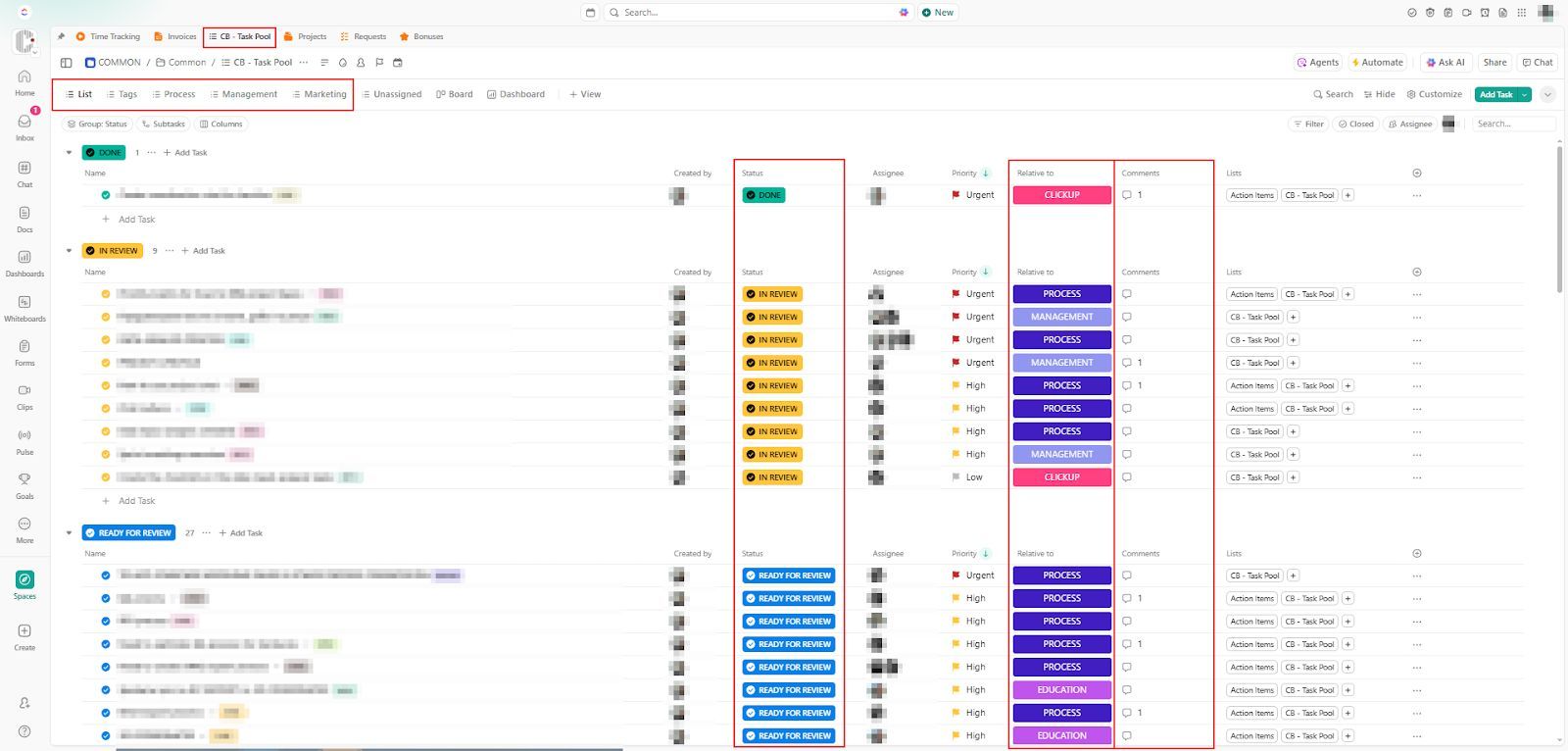
That is where our internal backlog comes in. We run our daily operations in ClickUp, so we set up a dedicated task list to collect these internal initiatives. It works as a living backlog that anyone can pull from when capacity is low.
What lands in the CB Task Pool tends to fall into a few groups. There are process improvements, such as learning a new tool or reworking an internal workflow. There are management tasks, like drafting documentation or updating our company standards. There are ClickUp tasks themselves, such as updating templates and tidying task structures. And there is educational content, where someone builds an internal presentation or writes up domain knowledge for the rest of the team.
What makes it work is that it is open to everyone. The whole team can see the list, add to it, and pick from it. Anyone can track progress, leave comments, or flag something that needs a wider discussion. Because people pick the tasks that genuinely interest them, the work actually gets done rather than assigned and resented.
What it changes
The effect is simple. Instead of drifting through downtime wondering what to do, people know exactly where to go when there is no client-facing work in front of them. The quiet time turns into steady, low-pressure progress on the tools, processes, and knowledge base that a busy schedule never leaves room for.
For us, that means the studio keeps getting sharper even when the project pipeline slows. For a client, it means the team you work with is not standing still between engagements. It is refining the way it works.
If you want to try it
None of this depends on ClickUp. Any task manager your team already uses will do the job. The part that matters is the backlog itself: transparent, open to everyone, and filled with internal work that is genuinely worth doing rather than busywork invented to fill a gap.
Downtime does not have to be wasted time. With a shared place to put the improvements everyone already knows are needed, the quiet weeks become some of the more useful ones. If you want a BIM partner that treats it that way, tell us what you are working on.